I realise I’m slightly late to the party here (though I do have years of BG measurements from both finger prick and CGM as T1 diabetic), I just wanted to add that if anyone is going to do this they might think of using the combination of the following apps to provide aligned (and 1min) data:
Juggluco (Juggluco) will read the libre(1,2,3) sensors and either log data, or my preference is to have it act as a data provider (using the “patched libre broadcast” setting - someone patched the original app so it would broadcast an Android intent, Juggluco simply replicates this Intent so other apps that can handle this can continue to use it.) The latest libre2 (and 3 I think) sensors provide 1min interval data.
XDrip+ (xDrip+) can use the “patched libre” as a data source (it can read sensors directly too, but using Juggluco provides 1min rather than 5min data) and provides a graph along with the ability to log carbs and finger pricks (which are then synchronised with the CGM data, with an offset applied to reduce/eliminate the CGM lag). XDrip+ will also talk to your watch (Android Wear, Garmin, amongst others) and provide a BG display on the watch, but perhaps more importantly for post-processing, it will also take the HR and steps data from the watch and log it in the XDrip+ database.
The XDrip+ database can be set to save a backup once a day (or exported at will) and this file is an SQLite database so you can then go and do whatever post-processing you fancy on it.
Had a few episodes of “very low” blood sugar (≤50 mg/dL) on 3 out of the first 6 nights. This triggers a VERY LOUD alert that can not be disabled – need to remember to switch off the phone at night
The FreeStyle Libre 3 stores more than 8h of readings, so switching off the phone at night doesn’t result in any lost data.
Comparison with a venous blood test I had at the same time: The Libre was 20 mg/dL higher, though the average glucose over the two weeks was only 6 mg/dL higher than the average calculated from the A1c. So I don’t think you can do a simple offset calculation to correct the values.
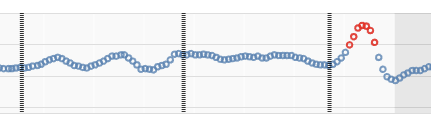
Here’s the largest glucose spike observed: Only minor bumps after having waffles soaked in maple and chocolate syrup for breakfast, more stable but slightly elevated glucose after soup and lots of bread for lunch, and then a huge spike when I had 2-3 tiny mochis at tea time. I wonder if the earlier meals set me up for reduced insulin sensitivity later in the day? Unfortunately there aren’t any continuous insulin monitors, and doing a blood test every 30min or so is expensive/painful…
Might try using the Levels or Veri app next time; both cost $40 for a month (if you BYO sensor), and I’m curious about their data analysis. XDrip+ looks interesting, but seems to be more of a full-time job?
Hi Eric, the last time I did this the device only provided download of algorithmically corrected values at 15 minute intervals. Has this changed? Are they giving you the same kind of data (recorded and adjusted) on five minute intervals now? I read somewhere that they are sampling every minute, but perhaps these samples are just inputs for the reported value, and and the system does some thinking first? Do you know?
The Libre 3 provides the same data, but in 5-minute rather than 15-minute intervals. The values are processed, so if you want to do your own calibration, you need to do some acrobatics to get at the raw data (see xDrip).
Using Libre 1 with Glimp app you get raw values with 1-minute resolution. You can calibrate it manually with finger prick and app will adjust raw values to fit manually added points and when you export data you get both raw and calibrated - that seems to be the best way to go if you want to play / analyse your data and there are no reason to go with libre v2 or v3 since they dont add much in comparison to v1 but make harder or impossible to get raw data in full resolution.
In calibrating with a finger stick (not that i would do it, too lazy), does it matter that the ISO standard requires measurements be within 15% of lab-based testing methods? I assume, perhaps wrongly, that the 1 minute sampling/five minute reporting processing methods are designed to take care of a number of sources of error using some kind of smoothing, so just a single calibration might not be very reassuring. But this is just speculation, if your curiosity has led you down this path I think it 's interesting.
I imagine that I would want to do multi-point calibrations if I was relying on the CGM for low blood sugar alerts. But in that situation I might prefer to trust Dexcom with my life anyway .
The higher data resolution the Libre 3 provides out of the box is nice but, doesn’t make a big difference to me. But not having to remember to tap the device every 8h is a big plus!
But first version was also accurate enough. So i dont see a big reason for having v3 which will not give raw data access
In calibrating with a finger stick (not that i would do it, too lazy), does it matter that the ISO standard requires measurements be within 15% of lab-based testing methods?
so just a single calibration might not be very reassuring.
I calibrate at a first day, just doing 3-4 pricks during in a 2-3 hours window, Glimp will not calibrated based on i single point. Adding few manual points will shift raw data curve a bit up or down without affecting it shape. But it doesnt really matter too much, because basically you are looking for iAUC compared between different products and when you look at ratio the base will cancel out.
I assume, perhaps wrongly, that the 1 minute sampling/five minute reporting processing methods are designed to take care of a number of sources of error using some kind of smoothing,
I did single experiment when i put libre 1, calibrated it and then gone to lab and made venous blood test for glucose and it matched perfectly.
1 minute sampling/five minute reporting processing methods are designed to take care of a number of sources of error using some kind of smoothing
This is an unknow blackbox algorhithm which hides real data from you. In QS experiments we often have problem with small sample sizes and this blackbox processing reduces your sample size by 5 times.
So, from my point of view blackbox processing which reduces your sample size 5 times and doesnt allow you to get you raw data is not something to go with, especially when there are good enough alternative with about same degree of accuracy (libre 1).
If your main goal is to get low sugar alerts i agree. But even Dexcom may have some bias and introduce some false / missed alerts, so it depends on what accuracy do you need with these alerting system.
The higher data resolution the Libre 3 provides out of the box is nice but, doesn’t make a big difference to me. But not having to remember to tap the device every 8h is a big plus!
As i know Libre 3 does not provide 1-minute raw data resolution for a full day, they provide it if the app is running and being connected to device to get some last samples from memory, i see people reporting they have a lot of gaps in these 1-minutes values in csv exports. In contrast Libre 1 allows for whole day raw data without gaps, but you need to tap 3 times. I agree that it is a big plus with Libre 3 that you dont need to tap often, but that results in raw data loss, so you significantly reduce your sample size. But if your goal is to get low sugar alerts that doesnt matter for you, so not a big deal.
Also i would note that Libre 1 usually costs 2 times less than Libre 3 Libre 1 can be reset without taking out so you can use it for 2 more weeks (my record was 6 weeks then battery and measurements went off) but V2 and V3 cant be restarted.
Not just “not often”, but never, as data is sent to the app via Bluetooth. This is a big plus for me because I am mostly just capturing the data for later review, not for real-time monitoring.
The no-insurance, out-of-pocket cost here in Seattle for the Libre 3 is less than $40 – the same I previously paid for the Libre 1, but this of course depends on your location and moon phase etc.
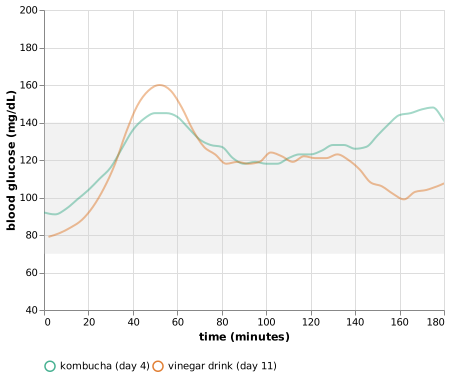
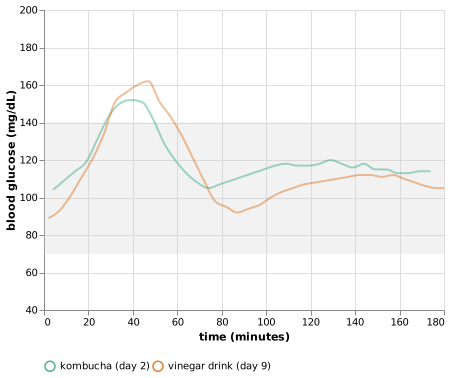
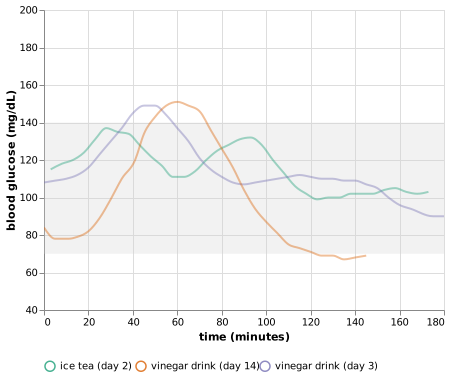
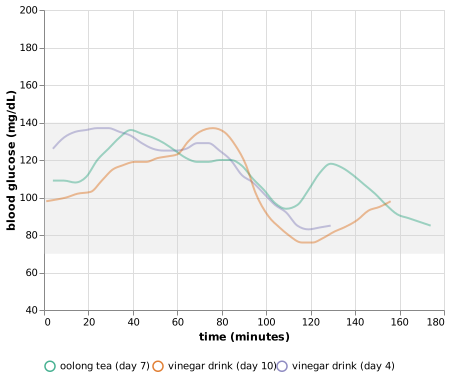
In addition to the “reference” meals provided by Tastermonial (cliff bars, rice crisp snacks), I tried the two most blood-sugar-spikey meals in my regular rotation, both with and without the vinegar drink (see charts below).
Doesn’t look like drinking vinegar had any impact on my blood sugar responses. Could be that there was a too-small-to-measure effect (the data is noisy, after all), or perhaps there would have been an effect after long-term use, or maybe it really just doesn’t do anything for me.
Also: I already knew to turn off the phone at night to avoid being woken up by bogus low blood sugar alerts, but this time I also got bogus alerts twice while exercising after a meal (which causes a sharp drop in blood sugar, though I never actually go hypoglycemic).
Thanks for sharing the data. Nice graph, by the way! From looking at the post-meal graph, we can still observe the delayed gastric emptying effect of vinegar, as illustrated by the delayed peak. However, as you mentioned, the data may suggest that apple cider vinegar (ACV) might not work as effectively for you, or other real-world variables (such as cortisols and other hormones) could be influencing the results. Perhaps you were stressed about drinking the vinegar
Additionally, you seem to have a double peak response (biphasic), which is often considered indicative of good insulin sensitivity. This biphasic response can imply that your body is effectively managing blood sugar levels by releasing insulin in two phases—first, a rapid release to handle the initial surge of glucose, and second, a slower, sustained release to manage the remaining glucose.
Did you notice any differences in satiety with or without vinegar? Understanding your subjective feeling of fullness can help determine whether ACV has an impact on your appetite and overall food intake.
I did not notice feeling full quicker during the meal, or getting hungrier before the next meal. But I feel like my hunger levels are about where they should be anyway.
No major lifestyle changes, so nothing much new to report; still making the same mistakes
I thought I could get away with drinking strawberry milk late in the evening after a workout, but no; plain milk or even chocolate milk is fine.
Speaking of milk (slightly off-topic): Switching to 2% milk appears to have lowered my non-HDL cholesterol a bit, but I cut back on whipped cream, so that might explain the drop, too.
Did a lab blood draw while wearing the sensor; the sensor reported a 10mg/dL higher fasting blood sugar, and the calculated A1C was 0.1 points above the lab-measured value.
Both Abbot and Dexcom now have direct-to-consumer sensors/apps, Lingo and Stelo. Abbot’s Lingo appears to be identical to their FreeStyle Libre sensor, minus the annoying alerts. Both cost around $50 for one two-week sensor, which is just slightly more than what a FreeStyle Libre had cost me. So I decided to get both a Lingo and a Stelo, and wear them next to each other for two weeks. Here’s what I found:
Both apps can export a CSV file with blood sugar readings, but neither include meals and activities in the export. Stelo does at least export a PDF report that includes everything.
Lingo’s readings were slightly above my venous blood sugar when fasted (as was often the case with the FreeStyle Libre), and Stelo added another ~5mg/dL on top of that, so not bad. But overall correlation between the two devices was not so great (r=0.79), even after accounting for a 5-minute lag with the Stelo (r=0.815). Lingo’s readings looked more plausible (none over 180 or under 70mg/dL, and no gaps), and it had me in the target range (70-140mg/dL) for 97.8% of the time (vs 93.1% with the Stelo), so I think I prefer the Lingo
Both apps were really nice: Readable graphs, easy food logging, automatic syncing of activities from other apps etc. It’s amazing what can be done when every small change doesn’t need to be re-evaluated for submission to the FDA!


 Libre 1 can be reset without taking out so you can use it for 2 more weeks (my record was 6 weeks then battery and measurements went off) but V2 and V3 cant be restarted.