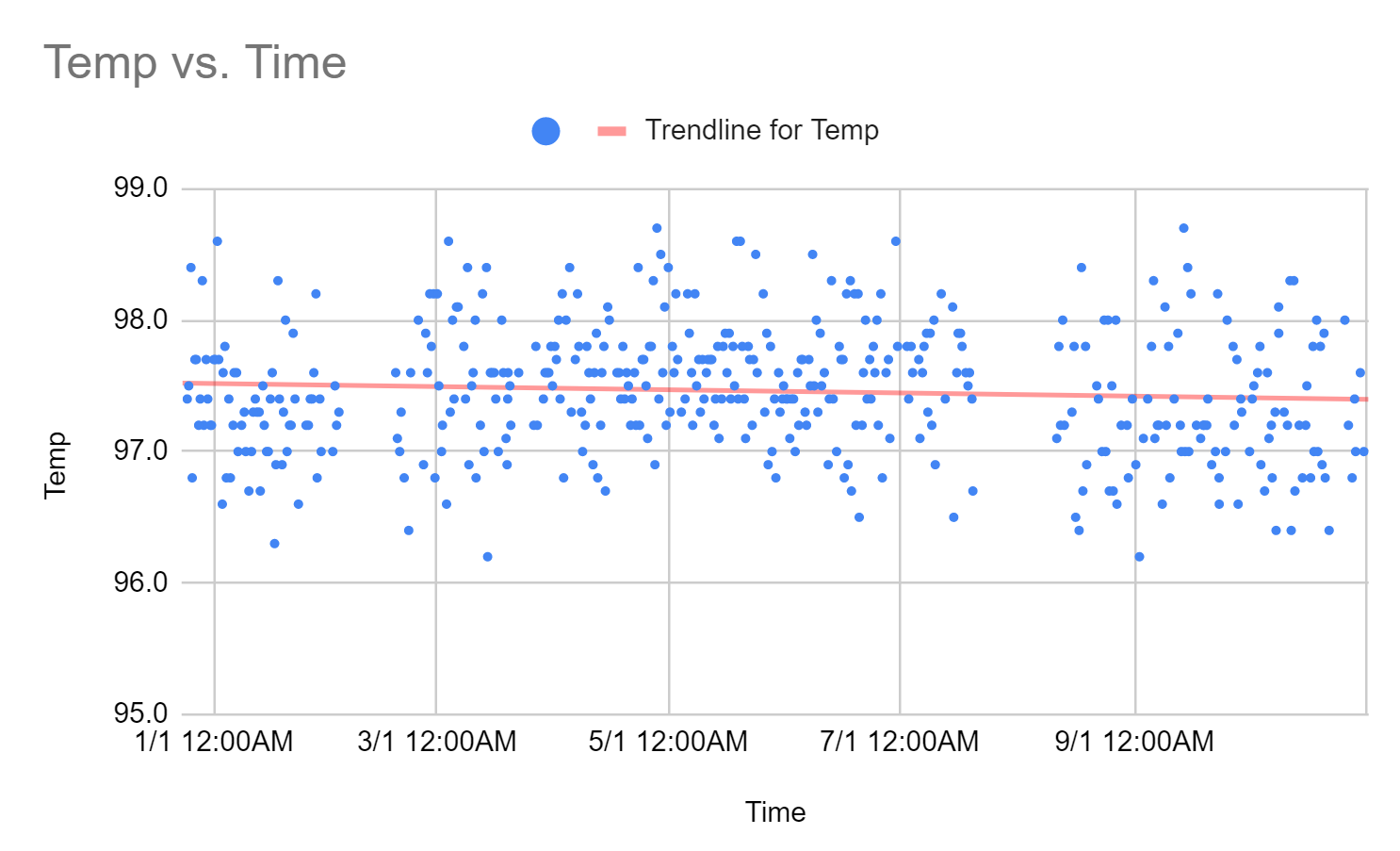
has anyone experimented with serial body temp and pulse readings and compared it with TSH levels? wonder if there is a correlation. There is not much reference to this as a surrogate for thyroid function in PUBMED.
I don’t have all of my body temp / pulse data easily available, but I think I’ve had a general correlation between those levels and thyroid bloodwork (free/total T3 and inverse correlation with TSH).
I think it might be important to account for other things that can raise the body temp and pulse (like stress) though.
I know my morning and daily temps tend to be pretty normal, say morning temp of 97.7 or above pre-ovulation and 98.4 or above post ovulation, rising throughout the day with an general average of 98.2-98.6. Depends on who you ask but my TSH tends to be on the lower end of normal: .5, .8, always less than 1. And my free T3 also is lower than optimal/normal from a functional perspective but within the lab ranges.
In my opinion this is not classic hypothroidism but low T3 syndrome/ Euthyroid sick syndrome. So maybe that is why I have normal temperatures. Or maybe as you are questioning, the correlation is not very accurate.
I don’t feel like my thyroid works well from a symptomatic perspective. I have cold hands and feet, fear being cold, weak hair and nails, sparse outer eyebrows, exhaustion. Two classic hypothyroid symptoms I do not have are dry skin and weight gain. I have very oily skin and cannot gain weight.
Dan , Emily–thanks for sharing your experiences…i am looking at tracking thyroid functions for hypothyroid. i think i will give it a pass now…and may be check it out later…
I at least find temp/pulse useful for spotting trends even though there’s more ambiguity than TSH. For example, I think these trends imply that weight loss causes my metabolism to drop and/or morning adrenaline/cortisol to rise:
While that’s not surprising, it’s a pattern that’d be harder to see with (somewhat-variable) TSH bloodwork, at least if done infrequently.
the reason a new biomarker is needed for hypothyroidism is that sometimes symptoms of hypothyroidism persist despite normalised TSH levels and TSH levels show circardian variations and vary with time of the day.
I asked Xiao Li, author of the recent wearables paper from the Snyder Lab, about looking into this connection. She had a question: How are you measuring TSH? Are these standard blood serum tests you get from a medical lab like LabCorp? How often are you doing them?
One of our family members is hypothyroid and i was looking for surrogate biomarkers that can replace TSH measurements.
TSH measurements are known to have large intraindividual variation and i doubt if the change in serial measurements can be considered to be clinically relevant.“The reference interval for TSH varies significantly by age, sex, hour of day, and ethnicity.”
I am not planning on TSH measurements other than what is within the primary care /insurance mandate at this point. I wanted to know if some one can point me to studies looking into correlation of BBT or pulse rate to TSH levels or symptoms of hypothyroidism.
I also have hypothyroidism and I have taken temperature and blood pressure measurements every morning and night, but the data is too variable for me to draw any conclusions from it. I’ve been thinking about getting a wearable tracker recently because of this. FYI Paul Robinson is big on using temperature and blood pressure for hypothyroidism, but he recommends taking temperatures 4-5 times a day.