Tracking improvements in verbal communication

Hi all,

I grew up speaking in very ‘sub-optimal’ ways, including pressured speech, not enunciating, and generally communicating ineffectively (probably due to a very rough childhood).

Recently, I’ve decided to measure and improve how I communicate by recording my conversations, transcribing them, measuring my mistakes (see below), and then rewriting my side of the conversation to reflect what I would’ve liked to have said.

My question is: How can I effectively quantify my communication skills?

So far, here’s what I’ve come up with:

Number of interruptions (and interruptions received)
Count of filler words
Time to interruptions (how long I let the other person talk before I interrupt them)
Time spent talking vs. listening
Average silence duration
Speech rate (words per minute)
Number and length of pauses in my speech
Number of breaths
Time focused on my topics of interest (also analyzing usage of “I,” “me” vs. “you,” and “we”)
Sentiment analysis – positivity vs. negativity
Topic shifts (how often I change the subject)

I’m looking for additional ideas on how to effectively quantify my communication skills.
What other metrics or methods would you recommend?

Has anyone else gone through a similar process? I’d love to hear about what worked for you.

Thank you,
NL

Not related to quantifying specifically, but here are some books that have been recommended to me:
Speak With Distinction by Edith Skinner
The Voice Book: Caring For, Protecting, and Improving Your Voice by Kate DeVore and Starr Cookman
Articulate While You Communicate: Speak Well, Write Well, Be Well by Dr. Sheryl L. White
Clear Speech: Pronunciation and Listening Comprehension in North American English, 4th Edition

Also thinking of practicing enunciation exersices (e.g. pen placed horizontally between your teeth forces you to really enunciate, though it’s tiring), using a telepromter app and generally finding role models and trying to model their speech.

5 Likes

This is so interesting! I’ve never really thought of how people could track their speech patterns themselves before, even though its a big topic related to public speaking and leadership communications. Thanks for posting about this in the forum.

I do have some ideas on what you can consider adding in. Part of being an effective communicator is working on active listening skills. That’s something that can be quantified to see if you’re improving. Counting clarifying questions and paraphrasing/summarizing in your conversations can track that.

You can also track unique words used and sentence complexity. Tone of voice is also incredibly important to be aware of, perhaps also track that.

I don’t know if you’re going to be doing a peer analysis to compare your data to, but that may be helpful to consider so you know what the numbers look like for what you consider effective communication.

Be sure you’re getting explicit consent to be recorded lol that could be considered part of being an effective communicator in itself. If people are willing, maybe they can also give you feedback you can consider. It’s not a “hard number” but effective communication isn’t had with yourself. The participant is worth asking!

2 Likes

Yeah, thanks. For sure, got to have consent!

I’ll incorporate your ideas as well - thanks again :wink:

1 Like

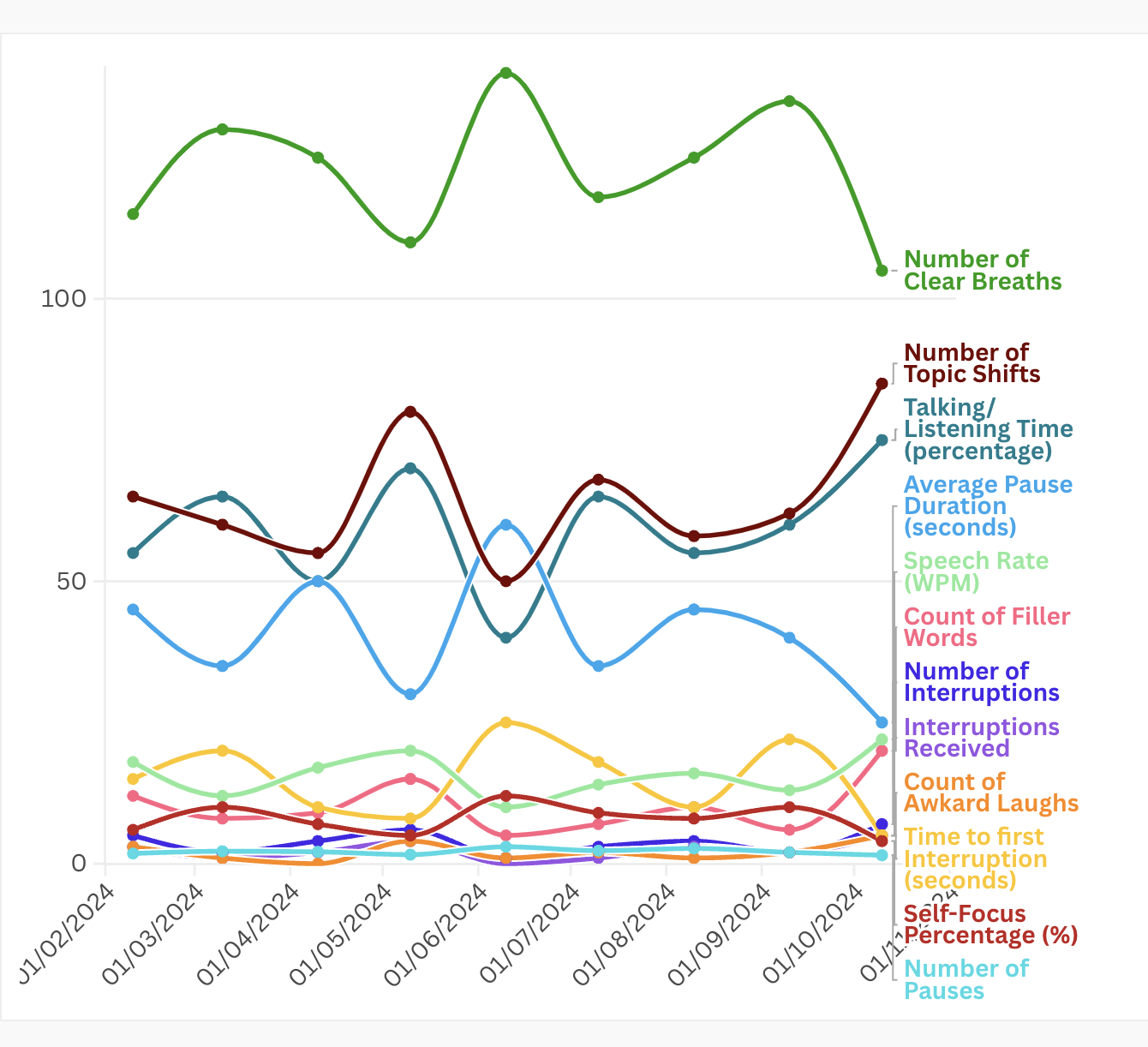
So, my idea is now to use Google sheets to measure the data and then import it into Flourish to get a nice visualisation (this is just random data as an example).

3 Likes

Super interesting project.

2 Likes

Hi, this is my first message today, because I’ve got almost the same project: quantifying my verbal communication to improve it after years of traumas that have impaired it. The ideas for things to track have given me a lot of insight, and I can see how to analyse them afterwards, but I still have one question: what tools should do you use to collect this data? I’m obviously not going to have fun counting occurrences manually.

2 Likes

Thank you for posting here, Nathan. I think @MrN is not planning to do this every day, but rather recorded some speech daily for a week to increase understanding and generate ideas. Recording conversations, then going back and listening is the method, and it seems to have worked. Sometimes an intensely demanding method (for a short time) is worth the effort.

If you want to track verbal phenomena on an ongoing basis you might consider isolating one or two typical issues and just tracking these manually. For instance, you could ask your friends or family members to let you know if you mispeak a word, and then just keep a tally.

You could use one or more of the available corpus linguistics tools (on a transcript of your speech). For quickness #LancsBox is good and generates some visuals go to https://lancsbox.lancs.ac.uk/ it runs on Windows Mac and Linux. If you are looking to do real in-depth and serious analysis then go check out Corpus Work Bench; check out it capabilities at IMS Open Corpus Workbench :: What is the CWB?. In both #LancsBox and CWB you can use CQP (the Corpus Query Language); one of the developers works on both programs. But while it does pretty everything a corpus linguist might want CWB is a monster.

Shouldn’t these be divided by the number of spoken words that day? Is it possible that you would give very different ratings today than you did at the time of rating? I mean does this project suffer from ratings skill and opinion shift?

Hi there! I’m actually building a tool that uses speech/voice analysis to help you continuously track and improve cognitive functions including verbal communication (in addition to others like mental acuity, cognitive stress, etc.). Our tech is backed by the latest neuroscience and voice biomarkers research and we’re looking for early users to help test and shape the product, let me know if you’re interested! (can drop your contact here: Airtable)